Sunday, March 31, 2013

Signed Qin Chen Yu - Chinese Peasant Painting (Folk Art)


Purchased on January 4, 2013

Artist signature - Qin Cheng Yu, in July 1991

Title - New Look for the Village

中国天津北郊现代民间画会 Tianjin North Village Contemporary Folk Art Club

Another Chinese chop mark

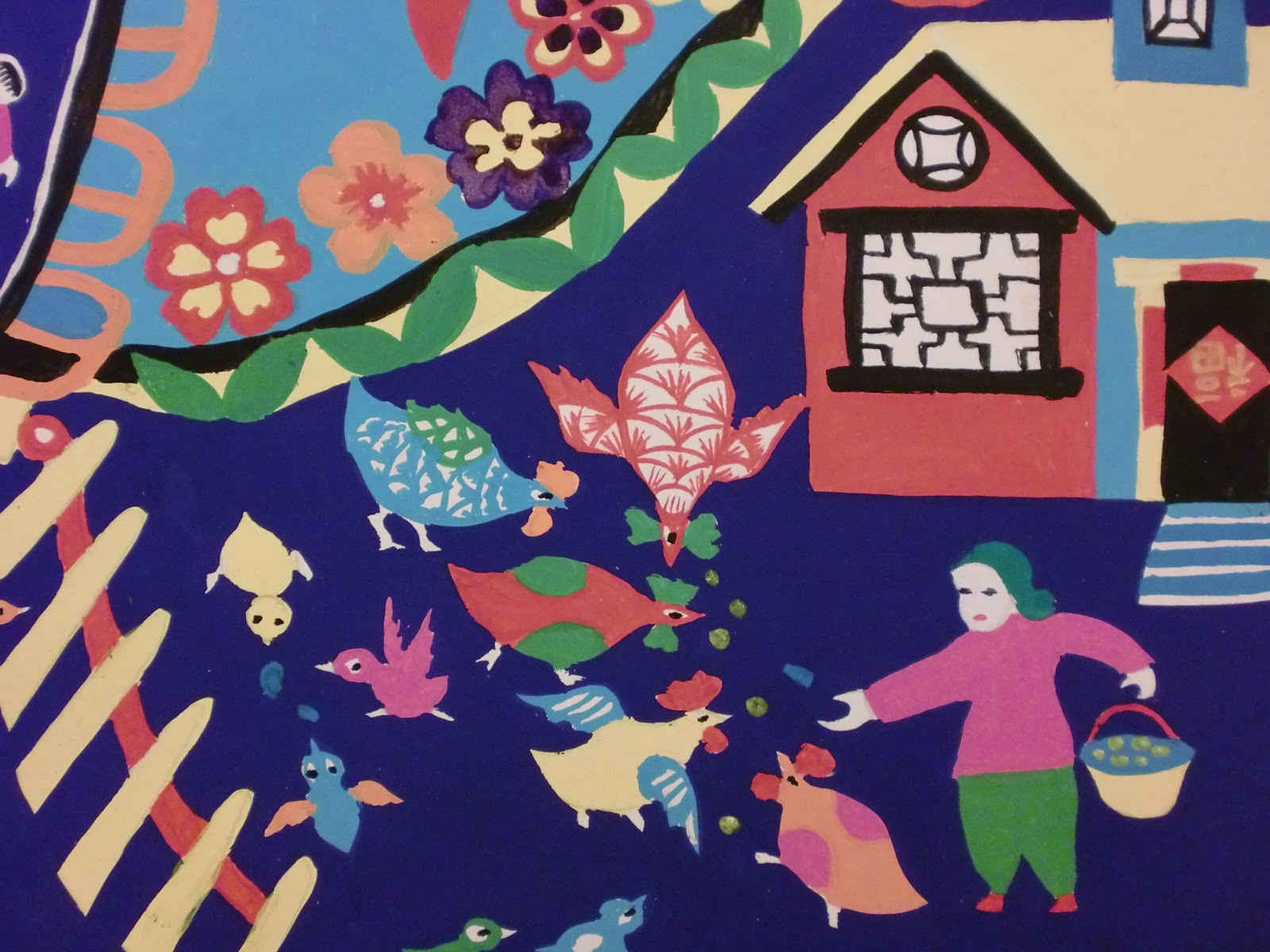
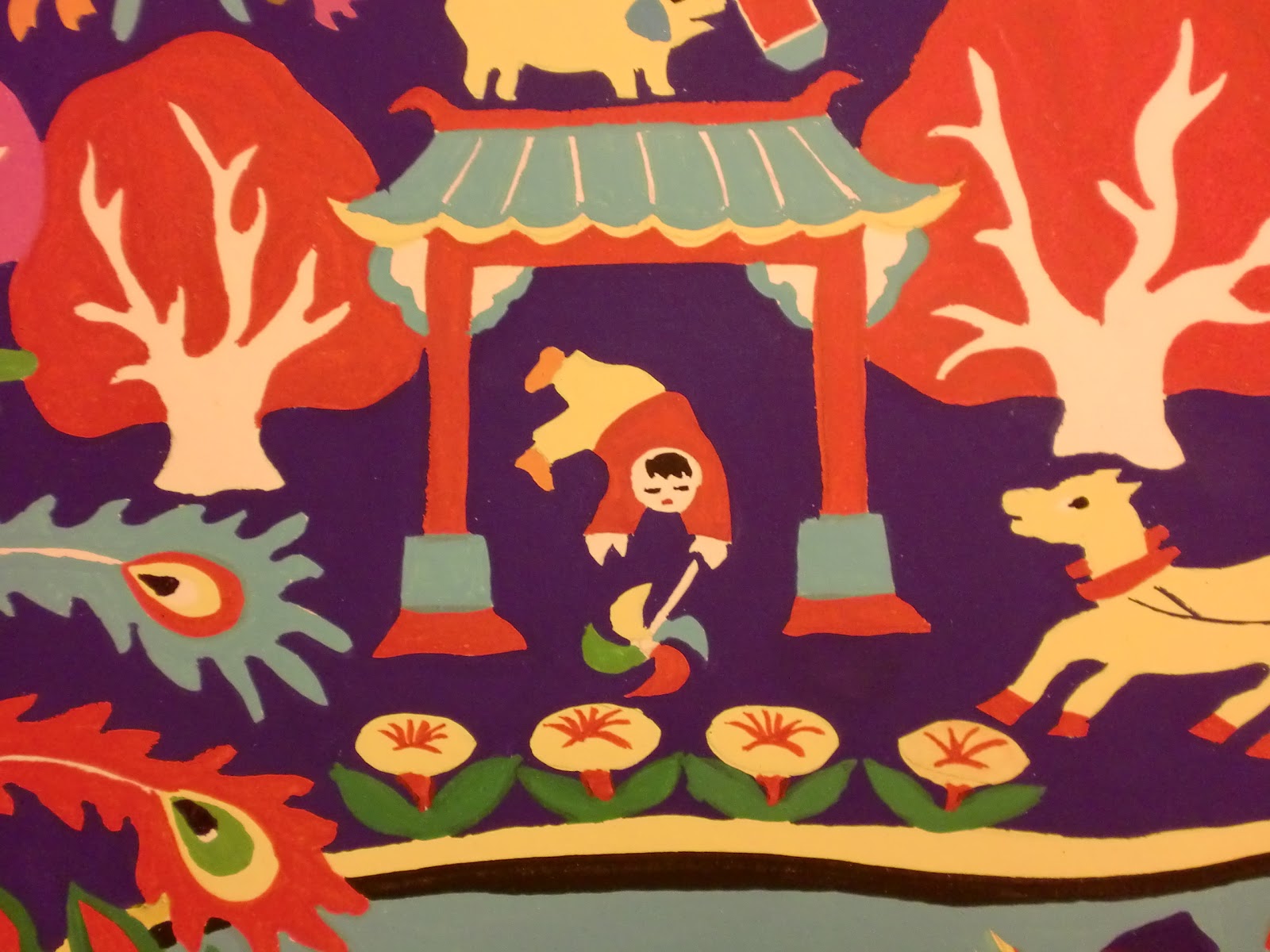
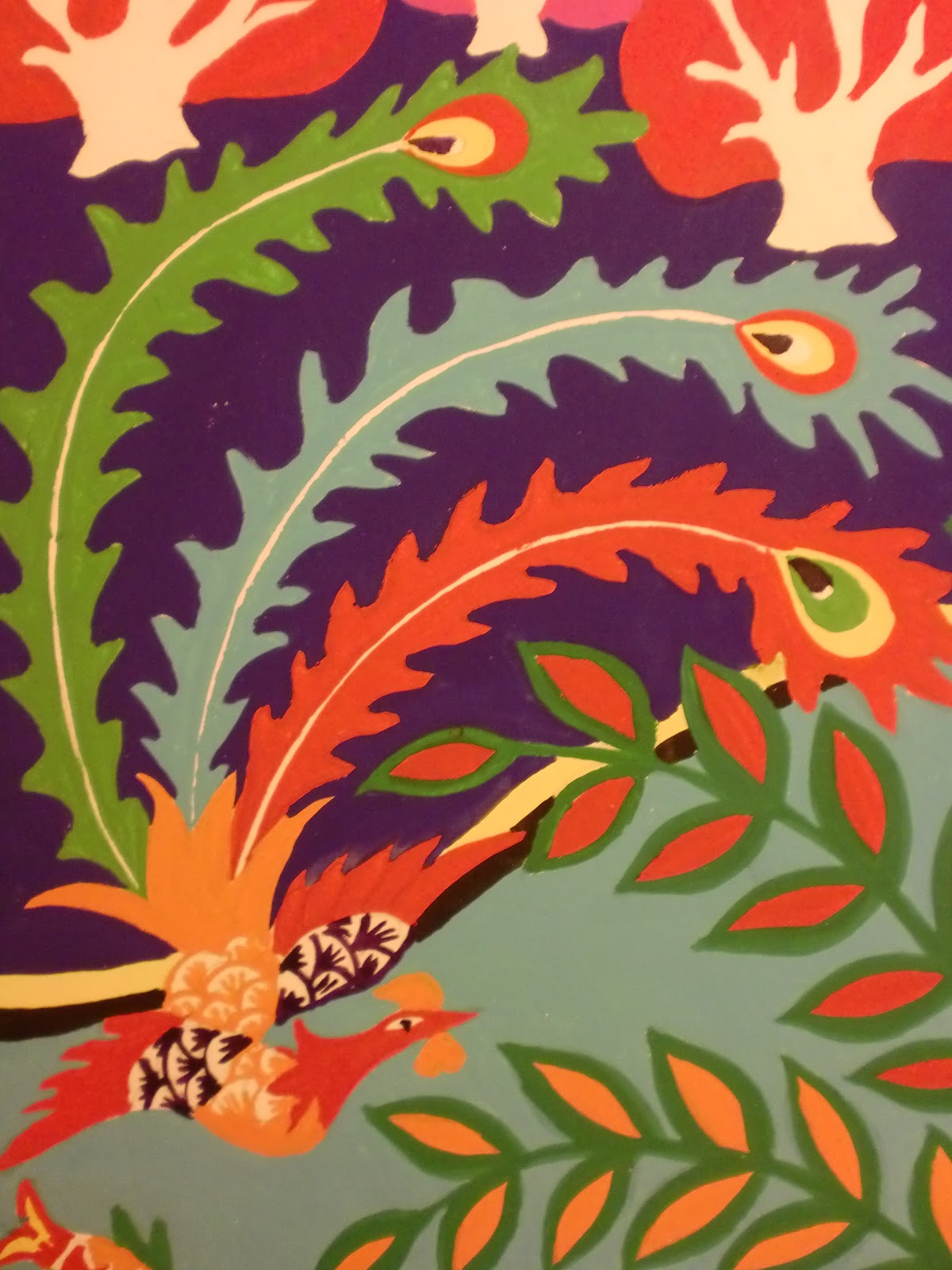
This is a very interesting painting in rich and detail descriptions on how farm lives are in China. Vivid colors and kind of like cartoonish style really made me smile everyday :-)


See the grandma is feeding those chicken

Are they breeding honeybees?

Women are lifting heavy stuff by using the bamboo carry pole


Use donkeys to transport bulky items

Toddler and mom crossing the bridge

Feeding fishes on a boat with goats surrounding by the river


Kids playing under the Chinese pavilion

Goats gathering?

Peacock!

Colorful tree and peacock - which looks better?

A flying bird is being drawn like a Phoenix

Bird mother is feeding her three babies

秦诚玉 Qin Cheng Yu (Born in June 1940) Graduated from High School in 1959, worked at editorial related position at army. He is a Chinese farmer who plants watermelon and corns, started peasant paintings in 1987 after taking a painting course in his village. After that, he did four paintings and they were all selected for an exhibition. He wants to paint a huge painting about their farm life and make one which is the biggest peasant painting forever.
Qin Cheng Yu is the father of four grown sons and currently lives on his farm with his wife.


Artist Reference:
http://www.redlantern-folkart.com/english/author_view.aspx?aid=16

Materials:
Plastic Frame, Transparent, 20' x 28', opening size 18.5' x 26.5'
Watercolor Gouache

Sunday, February 3, 2013

Signed Dr. Khosrow Salehi - Schloss Schonbrunn - Art print


Purchased on January 14, 2013


This is an Art print obtained from Chelsea New York, the enticing mix of watercolors has caught my eyes and made me to take it home. I have tried to do some research online however there is not much information for this artist. Here are some background for this beautiful palace in Austria and brief information about the artist. I hope one day I will have the opportunity to visit this place.


Schönbrunn Palace (German: Schloss Schönbrunn) is a former imperial 1,441-room Rococo summer residence in modern Vienna, Austria. One of the most important cultural monuments in the country, since the 1960s it has been one of the most popular tourist destination in Vienna, attended by millions of visitors each year.


233/350  Schloss Schonbrunn

Original Signature Signed by Khosrow 2003 Wien
 
At the corner of living room


Biography of Artist Dr. Khosrow Salehi and business card of Studio Wienblick were stuck to the back:


Dr. Salehi has dedicated his efforts to watercolour for well over 30 years and his work is recognizable for its brightness. After he obtained his Doctorate in Architecture in 1981, he attended 2 semesters at The Fine Arts Academy. In 1983 he studied Restoration of Monuments at the "Collegio degli Ingegneri Civili" in Florence.

He now resides in Tuscany and has an Art-Gallery called "Galleria Civetta" which located at:

Piazza Giacomo Matteotti, 42
50022 Greve In Chianti,
Province of Florence, Italy


Exhibitions:
1983 - Rassegna Internazionale dell'Acquerello, Roma.
1984 - "Cento Acquarellisti a Roma".
1985 - Galerie Lucardis, Vienna.
1986 - Mostra Collettiva; "Wien das Gesicht einer Stadt".
1988 - Dom Galerie, Wiener Neustadt, Austria.
1991 - Galleria Civetta, Greve in Chianti, Italia.
1995 - "Colori del Chianti", Palazzo della Torre, Greve.
1997 - "Impressioni del Chianti", S. Angiolo.
1998 - Mostra Internazionale, Nags Head, N.C. USA Honorable Mention.
2001 - Ex sede Monte dei Paschi di Siena, Greve.
Mostra permanente: Lepanto a Greve - Gallo Nero a Greve.
2002 - Esposizione grafica a Fortezza da Basso, Firenze.
2003 - Esposizione grafica al Castello Mediceo, Siena.


Art Print, originally watercolor
Image size: 7 x 9 in.
Frame size: 12.25 x 15.25 in.

Artist Biography:
http://www.artinfo.com/artist/231591/overview
http://www.art-wienblick.at/site_english/kuenstler.htm
http://www.galleriacivetta.it/index_EN.asp

Saturday, January 5, 2013

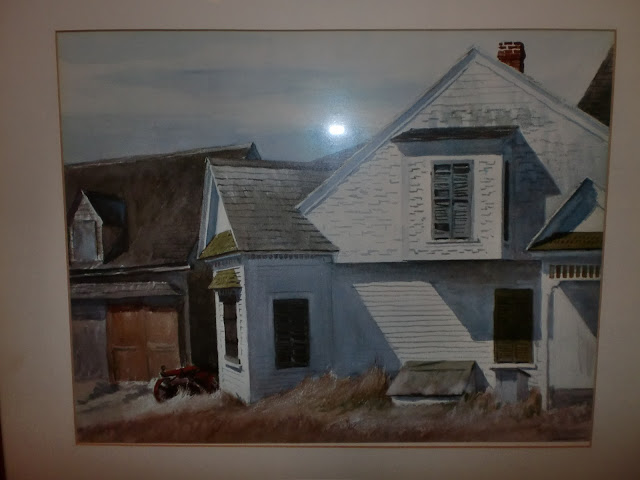
Edward Hopper - House on Pamet River - Art print


Purchased on December 21, 2012


House on Pamet River 1934

This is a framed art print by Edward Hopper which was painted in 1934 titled 'House on Pamet River'.
The original artwork is in Whitney Museum of American Art, New York.

In 1930, Edward Hopper and his wife, Josephine Hopper, decided to spend their summer in South Truro, MA. Hopper described the landscape of this isolated town near the tip of Cape Cod as composed of “fine big hills of sand — a very open almost treeless country.” The area’s wind-swept dunes and solitary houses provided a fresh source of inspiration for him that made his first summers there were among the most productive he had known.

In 1933, when Jo Hopper inherited some money, they bought a land and built a house in South Truro; the couple spent nearly every summer and early fall there for the rest of their lives. Although their house had breathtaking views of Cape Cod Bay, the artist never painted these vistas. As in Gloucester and Maine, he was not interested in producing such typical views. Instead, he often depicted one house standing alone in nature, conveying the remoteness and quiet of the sparsely populated area around Truro. During this time, Hopper began to create more monumental watercolors, using thicker and larger paper. He also simplified the area’s austere houses to emphasize their abstraction and, as in House on Pamet River, compressed the pictorial space.

As Scene painting dominated American art at that time period, artists were turned away from European-influenced abstraction toward more realistic depictions of specifically American places and regions. Hopper felt strongly that American Scene paintings caricatured American culture, and he rejected the attempt to create a national art. Painting for Hopper was an intensely personal act that “My aim in painting, has always been the most exact transcription possible of my most intimate impressions of nature.”

Edward Hopper (1882 - 1967)

Edward Hopper (1882 – 1967) produced some of the most enduringly popular images in American art. Throughout his career, he created quiet yet riveting pictures that express both sense of isolation and uncertainty and the bittersweet comfort of solitude. His images of apartments, diners, and movie palaces reflect American urban life between the world wars, while his light-filled watercolors of New England evoke that region’s austere beauty.

Born in Nyack, New York, along the Hudson River, Hopper did not come to artistic maturity until the mid-1920s - an age whose celebrated prosperity, enjoyed by the few, gave way to the Depression. Avoiding direct social commentary, his work reflects the contemporary interest in ordinary people and unexceptional places—subjects that in his hands became both evocative and insightful. The tall and taciturn artist painted images that have been described as spare, disciplined, honest, and even puritanical. Working slowly and deliberately, he pared scenes down to the essentials. While his paintings seem empty and silent, they are filled with an underlying tension, so that the slightest action—a gently rustling curtain or a piano key struck absently—takes on a mysterious significance.

Hopper's vision was unique. The people inhabiting his city and suburban scenes are lonely, anonymous, temporary inhabitants of sometimes inhospitable environments. When there is no human element, he transfers these qualities to the architecture or even to the landscape itself, using intense light to infuse human emotion.
Although the artist received many honors in his lifetime. Hopper himself made no great claims for his art. “What I wanted to do,” he said, “was to paint sunlight on the side of a house.”

There is a frugality in Hopper's work, a careful selection of people, buildings and interiors, just as there was to the man himself. He worked in the same studio on Washington Square for 54 years, rarely venturing out except for summers in New England and an occasional visit to the Southwest. He died in his studio on May l5, l967.

Edward Hopper is represented in every major institution in the US.

South Truro, MA - Cape Cod
 
Art Print, originally watercolor
Image size: 12.5 x 18 in.
Frame size: 18 x 21.5 in.

Artist Biography:
http://www.askart.com/AskART/H/edward_hopper/edward_hopper.aspx
http://www.artic.edu/aic/collections/exhibitions/hopper/capecod


References:
http://en.wikipedia.org/wiki/Edward_Hopper
http://en.wikipedia.org/wiki/Josephine_Hopper


Sunday, December 30, 2012

Amedeo Modigliani - Portrait of a Woman - Art Print


Purchased on September 20, 2012

Portrait of a Woman
 This is an art print purchased from a thrift store in Chelsea, I am not sure if this really a piece came by Modigliani... After I did some research online, I found one particular Ebay seller is selling this print. If you are interest in it, you may visit the link below to the seller store page.
On the back of the piece is an older label from ArtLore which located in New York City as a wholesale distributor of decorative art. I love how the frame and the mat color combined together - it is a vintage thick (in 2 inch) /sturdy wooden frame with my favorite green color mat!


Modigliani signature


Label from ArtLore on the back of the piece


With Flash

Amedeo Clemente Modigliani (July 12, 1884 – January 24, 1920) was an Italian painter and sculptor who worked mainly in France. Primarily a figurative artist, he became known for paintings and sculptures in a modern style, characterized by mask-like faces and elongation of form. He died at age 35 in Paris of tubercular meningitis, exacerbated by poverty, overwork and addiction to alcohol and narcotics.


References:
http://en.wikipedia.org/wiki/Amedeo_Modigliani
http://www.ebay.com/itm/Amedeo-Modigliani-14-x-18-PORTRAIT-OF-A-WOMAN-c-1900-Drawing-Montparnasse-Artist-/150802939153?pt=Art_Prints&hash=item231c8e3d11


Available on Ebay:
http://www.ebay.com/itm/Amedeo-Modigliani-14-x-18-PORTRAIT-OF-A-WOMAN-c-1900-Drawing-Montparnasse-Artist-/150802939153?pt=Art_Prints&hash=item231c8e3d11

Friday, November 30, 2012

Siberian Tiger - Acrylic (Plaid Paint by Number)


Completed in November 2012


As the movie directed by Ang Lee "Life of Pi" has such a big hit in the world. I decided to show off my Siberian Tiger painting here which looks very similar to one of the survivors at the movie - a Bengal tiger named Richard Parker.


Plaid Paint-by-Number 16" x 20"
 
What not make me very satisfied for this painting is the look of its eyes - I don't feel it cautious enough and the strength and power of this big cat are not catching my attention either. My hubby agrees with me too! maybe the surroundings are covered in snow make this tiger looks so beautiful but a little bit weak.

I know I had done a very sloppy job this time, see the big cat's left whiskers... (i.e. right lower side at below close-up picture) obviously the light purple-blue line was mistakenly painted!


Close-up
 
By the way, I feel the quality of this acrylic paints from Plaid Enterprise are better than Dimensions. Why? Because I have few pots from Dimensions are either turned grainy or very liquid that I need to stir thoroughly until it completely smooth. For Plaid's I don't have any problem at all even I believe this Plaid kit is older than those Dimensions I completed couple months ago. Below is the progress:

 
30% Done


90% Done

Supplies contain in the package of this Plaid Paint By Number are same as Dimensions, for details please visit my other posts in this year for Dimensions Paint by Number.

Enjoy!


Sunday, October 28, 2012

Signed James Sanford Hulme - MacDougal Street, Greenwich Village, NYC - Colored Silk-Screen Serigraph

I found my first and second artworks by James Sanford Hulme at a thrift store this August! I was firstly thought they are both lithograph, but when I read closely to a 56 years old "The Village Voice" newspaper on Google, I realized that they are very likely be silk-screen serigraph that produced by the artist.

So, what is lithograph?
A lithograph is a type of printing process during which an original artwork can be printed and reproduced, created by an artist or other skilled craftsmen. The process for creating lithographs does not require a print-maker to first etch the image into metal plates. Prints can be made of original artwork, first created on a stone table or metal plate, and images from paintings or drawings can be duplicated with this method. If the quality of a lithograph is excellent and the production numbers are low, it could have significant value in the art world.

What is serigraph or silk screen serigraph?
Serigraphy is a combination word from Seri (means ‘silk’ in Latin) and graphein (means ‘to write or draw’ in Greek).
Silkscreen or serigraph is a color hand-stencil printmaking process that uses a fabric screen for printing; the special paint is forced through a fine screen onto a paper beneath, areas which not print are blocked in each of the stencil screens. Then a sheet of high quality archival paper is inserted under the screen and special paint poured along the edge of frame. Squeegee is pulled from back to front for producing a direct transfer of the image. To color, it requires separate stencil for each color in each serigraph. This type of printing can be done relatively fast and many colors can be used.
Screen printing was first appeared in China during the Song Dynasty (960–1279 AD). It was then adapted by Japan and largely introduced to Western Europe in late 18th century, however it did not gain large use in Europe until silk mesh was more available for trade from the east.

Lets look at my #2 collection - MacDougal Street, Greenwich Village, NYC:


Purchased on August 29, 2012


See how colorful it is for the buildings, cars and pedestrians
  
Look at the dog! His reflection is in the car exterior
  
 
On the top of the building, you may find the NY's iconic water tank
  

Typical American-style fire escapes mounted outside of the yellow building
  

Taken with flash


Original handwritten title


Original Signature

Below is an article from The Village Voice, September 5, 1956 that reports James Sanford Hulme very first art show in Washington Square, NYC:


James Sanford Hulme was a painter, print maker and illustrator who lived for many years in White Plains, New York, and completed many serigraphs of his surroundings in Westchester County. Of special interest to him were local landmarks that he worked to preserve.

He was born in Oklahoma in 1900 and passed away in New York in 1974, he studied at the Art Institute of Chicago with Elmer Forsberg, whose specialty was print media. He also studied at the Grand Central Art School and took etching and lithography from George Bellows and Joseph Pennell. He served on the faculty of the Chicago Art Institute and then went to New York City to work as an illustrator. Commissions included magazines such as "Boys' Life", "People's Home Journal" and "Liberty Magazine", and in 1933, Hulme illustrated "Robbers Roost" by Zane Grey (1933). He also did technical illustrations for companies, developed drawings for desert warfare equipment and did drawings for NASA including for the Apollo space program.

Hulme was a member of the of the Brooklyn Society of Artists; Federated Artists Guild of America; Hudson Valley Art Association; and Chappaqua Art & Craft Guild. Exhibition venues included the American Watercolor Society, Riverside Museum, Philadelphia Watercolor Society and the Art Institute of Chicago. His works are part of the permanent exhibition of the Grange College, Bengal, NY; Wesleyan College, Macon, GA; and Knaben-Volkschule, Gustrow, Mecklenburg, Germany. He is listed in "Who Was Who in American Art;" "The Artists Bluebook;" "Index of Artists (Mallett);" "Mallett Library of Reproductions;" and "Artist Biographies Master Index (McNeil)."

Image size: 9" x 11"
Frame size: 14" x 18"
Colored Silk-Screen Serigraph, signed
Artist Biography:
http://www.askart.com/AskART/artists/biography.aspx?artist=125948
Artist news on The Village Voice:
http://news.google.com/newspapers?nid=1299&dat=19560905&id=IN4QAAAAIBAJ&sjid=EIwDAAAAIBAJ&pg=6239,2597842

References:
http://en.wikipedia.org/wiki/Screen_printing
http://www.hernandezfineart.com/serigraf.htm
http://www.wisegeek.com/what-is-a-lithograph.htm
http://dictionary.reference.com/browse/serigraphy?r=14

Saturday, October 27, 2012

Signed James Sanford Hulme - The Twin Gables House, Greenwich Village, NYC - Colored Silk-Screen Serigraph


I found my first and second artworks by James Sanford Hulme at a thrift store this August! I was firstly thought they are both lithograph, but when I read closely to a 56 years old "The Village Voice" newspaper on Google, I realized that they are very likely be silk-screen serigraph that produced by the artist.


So, what is lithograph?
A lithograph is a type of printing process during which an original artwork can be printed and reproduced, created by an artist or other skilled craftsmen. The process for creating lithographs does not require a print-maker to first etch the image into metal plates. Prints can be made of original artwork, first created on a stone table or metal plate, and images from paintings or drawings can be duplicated with this method. If the quality of a lithograph is excellent and the production numbers are low, it could have significant value in the art world.

What is serigraph or silk screen serigraph?
Serigraphy is a combination word from Seri (means ‘silk’ in Latin) and graphein (means ‘to write or draw’ in Greek).
Silkscreen or serigraph is a color hand-stencil printmaking process that uses a fabric screen for printing; the special paint is forced through a fine screen onto a paper beneath, areas which not print are blocked in each of the stencil screens. Then a sheet of high quality archival paper is inserted under the screen and special paint poured along the edge of frame. Squeegee is pulled from back to front for producing a direct transfer of the image. To color, it requires separate stencil for each color in each serigraph. This type of printing can be done relatively fast and many colors can be used.
Screen printing was first appeared in China during the Song Dynasty (960–1279 AD). It was then adapted by Japan and largely introduced to Western Europe in late 18th century, however it did not gain large use in Europe until silk mesh was more available for trade from the east.

Lets take a look of my #1 collection - The Twins Gables House, Greenwich Village, NYC:

Purchased on August 29, 2012


The Twin Gables


A two storey house built next to The Twin Gables 


Taken with flash


Original hand written title


Original signature

Below is an article from The Village Voice, September 5, 1956 that reports James Sanford Hulme very first art show in Washington Square, NYC:


James Sanford Hulme was a painter, print maker and illustrator who lived for many years in White Plains, New York, and completed many serigraphs of his surroundings in Westchester County. Of special interest to him were local landmarks that he worked to preserve.

He was born in Oklahoma in 1900 and passed away in New York in 1974, he studied at the Art Institute of Chicago with Elmer Forsberg, whose specialty was print media. He also studied at the Grand Central Art School and took etching and lithography from George Bellows and Joseph Pennell. He served on the faculty of the Chicago Art Institute and then went to New York City to work as an illustrator. Commissions included magazines such as "Boys' Life", "People's Home Journal" and "Liberty Magazine", and in 1933, Hulme illustrated "Robbers Roost" by Zane Grey (1933). He also did technical illustrations for companies, developed drawings for desert warfare equipment and did drawings for NASA including for the Apollo space program.

Hulme was a member of the of the Brooklyn Society of Artists; Federated Artists Guild of America; Hudson Valley Art Association; and Chappaqua Art & Craft Guild. Exhibition venues included the American Watercolor Society, Riverside Museum, Philadelphia Watercolor Society and the Art Institute of Chicago. His works are part of the permanent exhibition of the Grange College, Bengal, NY; Wesleyan College, Macon, GA; and Knaben-Volkschule, Gustrow, Mecklenburg, Germany. He is listed in "Who Was Who in American Art;" "The Artists Bluebook;" "Index of Artists (Mallett);" "Mallett Library of Reproductions;" and "Artist Biographies Master Index (McNeil)."

Image size: 11.25 x 9 in.
Frame size: 18 x 14 in.
Colored Silk-Screen Serigraph, signed

Artist Biography:
http://www.askart.com/AskART/artists/biography.aspx?artist=125948

Artist news on The Village Voice:
http://news.google.com/newspapers?nid=1299&dat=19560905&id=IN4QAAAAIBAJ&sjid=EIwDAAAAIBAJ&pg=6239,2597842


References:
http://en.wikipedia.org/wiki/Screen_printing
http://www.hernandezfineart.com/serigraf.htm
http://www.wisegeek.com/what-is-a-lithograph.htm
http://dictionary.reference.com/browse/serigraphy?r=14